
The short version
Which AI agent use cases are most likely to stick?
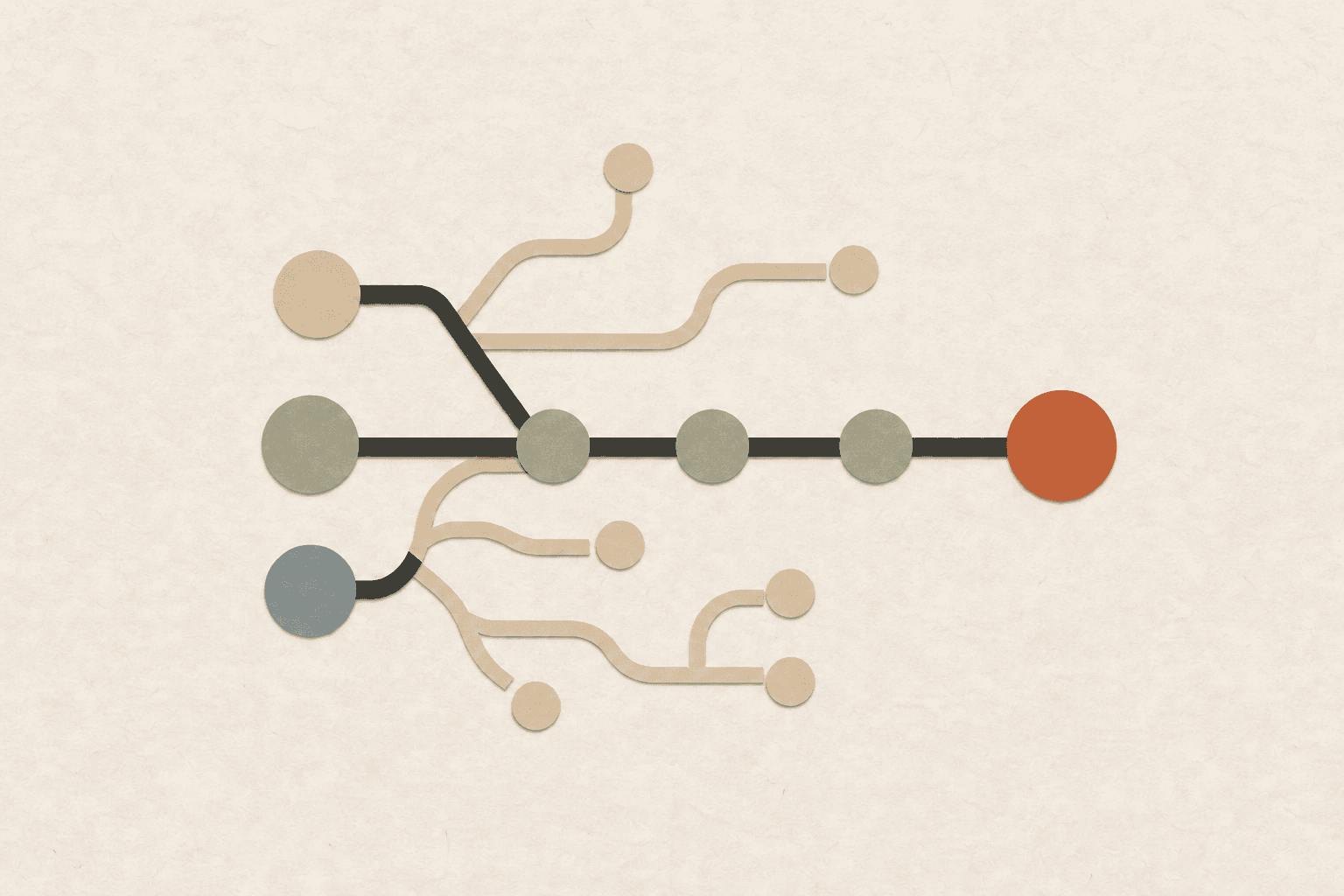
AI agent use cases stick when the work happens often, causes real pain, can be delegated with available inputs, ends in a verifiable result, and fits inside tolerable failure and permission boundaries. Start with one repeatable behavior—not a general assistant—and prove that it produces accepted outcomes with less effort than the existing workflow.
What holds up
- Capability creates options; a repeatable behavior creates adoption.
- Gate use cases on delegability, verifiability, and acceptable failure before scoring upside.
- Narrow vertical workflows usually absorb integrations and policy better than open-ended assistants.
- Measure repeated accepted outcomes and retained usage, not demos, prompts, or sign-ins.
Capability is not the same as adoption
In a widely discussed August 2026 post on X, Josh Miller observed that people outside technology still use AI mostly as search and writing assistance despite capable models, harnesses, and vertical-agent startups. His question was behavioral: why has an “AI agent” habit not become as legible as ordering a car or sharing a photo?
The answer will not come from a longer feature list. People adopt a tool when it becomes the easiest reliable way to complete something they already need to do. The job must recur often enough for setup and trust to compound instead of resetting on every attempt.
A company should therefore select an agent use case before selecting an agent platform. Start with the repeated decision or deliverable, the person who owns it, and the evidence that proves it was completed correctly.
Use six tests for a durable agent job
A promising use case does not need a perfect score on every dimension, but three conditions are gates: the work must be delegable, the result must be verifiable, and the worst credible failure must be tolerable or controllable.
- Frequency
- The work recurs often enough for users and the system to learn a stable routine.
- Pain
- Delay, repetition, cost, or cognitive load gives the user a reason to change behavior.
- Delegability
- Inputs, rules, tools, and escalation conditions can be expressed without hidden human context.
- Integration
- The agent can reach the systems of record without a fragile setup ritual.
- Verifiability
- Tests, authoritative records, review rubrics, or downstream outcomes can confirm success.
- Failure cost
- Errors are reversible, detectable, or gated before they become consequential.
Gate first: Can the work be delegated, verified, and bounded? Rank second: Is it frequent and painful enough to justify changing behavior?
Compare use cases at the level of work
Broad labels such as “sales agent” or “personal assistant” hide the actual operating conditions. Compare concrete units that begin with available inputs and end in an observable result.
| Unit of work | Why it can stick | Primary constraint |
|---|---|---|
| Implement one scoped software change | Files, tests, and review create a fast feedback loop | Repository complexity and permission boundaries |
| Diagnose one production incident | High pain and evidence-rich tools justify immediate attention | Sensitive runtime access and rare edge cases |
| Resolve one support ticket | High frequency, known policies, and accepted outcomes | Exceptions, tone, and account permissions |
| Produce meeting follow-up | Frequent, low-risk, and easy to review | Low value if the output is not connected to action |
| Book one multi-party meeting | Clear result and repeated coordination pain | Calendar policy, preferences, and external side effects |
| Handle any personal task | Large theoretical surface | Irregular demand, broad access, and ambiguous success |
Coding agents reveal the adoption pattern
Coding became an early agent category because the work already lives in a machine-readable environment. The agent can inspect files, run commands, change code, and receive fast feedback from tests and compilers. A human reviewer can inspect the patch before it reaches production.
The user also understands the setup cost. Developers already work in terminals, editors, repositories, and issue trackers, so connecting an agent does not require teaching an entirely new operating model.
This is why the model and harness matter together: the model proposes work, while the harness supplies tools, context, verification, and control. Categories outside software need an equivalent feedback loop rather than a chat box with more permissions.
Vertical agents package the missing context
A vertical product can make one job legible by packaging the data source, tool contract, policy, and outcome. HyperProbe, for example, describes a narrow path from a production alert to read-only evidence and a proposed root cause. The product does not ask a user to design a general on-call agent from scratch.
Cloudflare OS reports another approach: company-curated context and skills, connected internal systems, persistent workspaces, and shareable outputs. Cloudflare says thousands of employees across functions used its internal first version daily before the company released the newer platform as open source.
Both examples move setup into the product. The user experiences a job and its result, while the system absorbs identity, context, integrations, and guardrails.
Do not confuse easy output with valuable work
Meeting summaries, generic research, and polished drafts are easy to demonstrate because almost any plausible output looks complete. They become durable only when the output changes a downstream state: a decision is recorded, an owner accepts a task, a customer issue is resolved, or a qualified opportunity advances.
Define the accepted outcome before launch and connect it to the AI agent ROI baseline. If the output still requires a person to reconstruct the context and perform the real work, the agent may have added another inbox rather than removed a job.
Pilot one behavior for thirty days
Choose one team, one owner, one unit of work, and one acceptance bar. Give the agent only the integrations and permissions required for that behavior. Preserve the prior workflow as a baseline during the pilot.
| Pilot field | What to define | What to measure |
|---|---|---|
| Trigger | The event that starts the work | Eligible volume and missed triggers |
| Inputs | Required records, context, and permissions | Missing-input and access-failure rate |
| Outcome | The observable accepted result | Accepted, corrected, rejected, and abandoned work |
| Handoff | When and how a person takes over | Escalation rate and review time |
| Economics | Baseline and full operating cost | Cost and cycle time per accepted result |
| Retention | Who should keep using it after the pilot | Repeated use after novelty and reminders decline |
Measure behavior, not account activity
Sign-ins, prompts, generated tokens, and saved time estimates are weak adoption signals. Count how many eligible units entered the workflow, how many produced accepted outcomes, how often users returned without prompting, and whether the old path declined.
Interview users who stopped. A failed result, missing integration, unpredictable delay, or unclear review burden often matters more than model quality. Instrument the abandonment point so product feedback is tied to a real stage of the work.
The durable habit is visible when the team begins to treat the agent path as the default and reserves the old workflow for exceptions—not when early adopters generate more activity inside the tool.
Stop when the job does not compound
Retire or redesign a pilot when the work is too rare, inputs remain manual, outcomes cannot be verified, failures demand more review than the baseline, or users return to the old path once reminders stop. A capable agent does not rescue a weak job definition.
The strongest use case creates a loop: repeated work produces evidence, evidence improves instructions and evaluation, and better reliability increases the share of work users delegate. That loop—not general intelligence—is what makes an agent stick.
Evidence trail
Evidence, limitations, and sources
Grid Field Notes synthesizes published technical, product, and risk evidence into operating guidance. Vendor-reported results remain attributed, numerical examples are illustrative, and customer results appear only when they are explicitly measured and identified.
Limits of this note. This note combines a public adoption argument with published field evidence and current product cases. It offers selection criteria, not causal proof that any one agent category will achieve durable adoption.
Frequently asked questions
Questions teams ask
What is the best first AI agent use case for a company?
Choose a frequent, painful, bounded workflow with available digital inputs, a verifiable result, reversible failures, and one accountable owner. Support triage, scoped software work, and read-only operational investigation often fit these conditions.
Why do AI agent pilots fail to reach adoption?
Common causes are infrequent work, manual setup, missing integrations, ambiguous outcomes, excessive review, and failure costs that users do not trust the system to manage. More model capability does not remove those workflow constraints.
How should AI agent adoption be measured?
Measure eligible work entering the agent path, accepted outcomes, correction and escalation rates, repeated unprompted use, and decline of the old workflow. Do not treat prompts, tokens, sign-ins, or generated drafts as proof of adoption.